
Ban Josip Jelacic's installation sabre

|
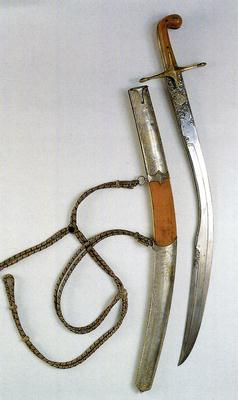
first half of the 19th century Silver, bone, steel, wood, velvet, forging, casting, carving out, engraving 81.5 x 67 x 4 cm A Turkish sabre. The hilt is made of brown bone with curved onion-like back-piece. The quillons are made of silver with straight, profiled endings and a thin, two-pointed langet in the middle. The blade is single-edged, curved, with a pronounced double-edged tip. Both sides of the blade have relief decorations - arabesques and cartouches in gilt with Arabian inscriptions that can be translated as: 'I have put my trust in Allah. There is no hero greater than Alia, nor a sabre better than Zulfikar.' Wooden scabbard, sheathed in reddish velvet, the mouthpiece and chape are long silver fitments with decorations. The edges of the fitments with two rings for attaching to the cord. The cord is made of interwoven red, silver and blue strands. The Jelacic estate, 1937. M. Sercer, Sablje, Zagreb, 1979; M. Sercer et al, Znamenja vlasti i casti u Hrvatskoj u 19. stoljecu, Zagreb, 1993, catalogue number 70. The catalogue description is partly taken from Marija Sercer, from the catalogue Znamenja vlasti i casti u Hrvatskoj u 19. stoljecu, Zagreb, 1993. The name Alia is that of Mohammed's son-in-law, and Zulfikar was the name of Mohammed's famous and often invoked double-edged sabre, that later belonged to Alia. |
|
HPM/PMH-011574 |


 |