
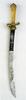
Hunting knife with inscription 'V:(ivat) PANDUR'
|
Germany, Solingen made by Johannis Beugel (1650-1680) 17th to 18th centuries Steel, brass, horn, leather, wood, forging, casting, incising 56 x 42.5 x 2.8 x 44 cm The handle is made of grooved horn with the pommel widened, riveted at the top and decorated with rays and faces of mascarons. A narrow ring is placed below the handle. The crosspiece is short, curved in different directions, ending in the heads of feathered wild animals. The central part of the crosspiece is decorated with a volute with baroque curves extending from it. The guard is bird-shaped. The single-edged blade becomes double-edged towards the handle, slightly curved. On both sides of the blade there is a depiction of a pandur (militiaman) on a pedestal that gets narrower in a step-like fashion. The inscription above the depiction reads: V:(IVAT) PANDUR, with three Greek crosses. Under the inscription is a knitted ribbon with leaf-like baroque endings. The tang of the blade holds the hallmark of the 17th century German armourer Johannis Beugel (head in profile with a ribbon on the chin). At the spine of the blade are stylised flowers. The scabbard is wooden, coated with brown leather and studded at the opening and at the top. Found in Germany, in Schaffhausen. Bought from Dr Fran Gundrum, the city physician in Krizevci, in 1911. M. Sercer, Macevi, bodezi, nozevi, Zagreb, 1976, catalogue number 360. The catalogue description is partly taken from Marija Sercer, from the catalogue Macevi, bodezi, nozevi, Zagreb, 1976. |
|
HPM/PMH-001867 |


 |