
Flag of the Pozega riflemen
|
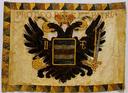
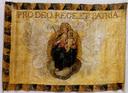
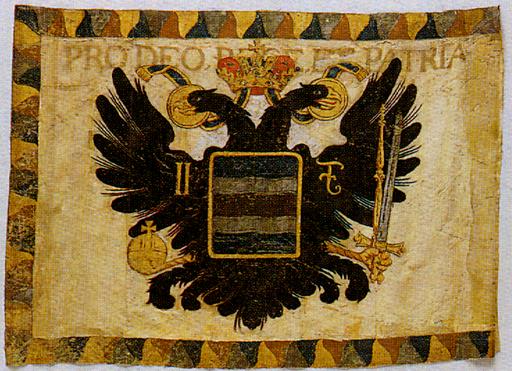
beginning of the 19th century White silk, painting, wooden flagstaff, gilt bronze finial 126 x 182 cm, length of flagstaff 302 cm Rectangular flag sewn of four pieces of silk, the edges decorated with alternating gold, blue, silver and brown flames. Obverse: in the centre of the flag field an Austrian Imperial double-headed eagle bears a square shield with the elements of the coat of arms of the Kingdom of Slavonia and the initials of the ruler F II (Francis II). Reverse: in the centre of the flag field a depiction of the Mother of God with the Infant Christ. Above the image the motto reads: PRO DEO REGE ET LEGE ('For God, king and law'). The flagstaff is spirally coloured in white, blue, yellow and brown, ending with a foliate filial with the carved initials: F II (Francis II). The flag was the so-called Leibfahne of the Pozega Jaeger battalion. The flag was donated to the Museum by Teodor Kraljevic, the parish priest in Pozega in 1906. The flag was restored by Iva Cukman (textile) and Alma Orlic (painting) in 1990. Streamer 1801 Yellow silk atlas, while silk, silver acupiction embroidery, sequins length of streamer 258 cm, width 14 cm A simple streamer decorated with a simple silver border along the edge and an embroidered inscription along the ends of the streamer edged with stylised branches. The inscriptions on the ends read: MARIA.THERESIA / AVG / VEXILUM.HOC.ET / FASCIAM.ADNEXAM / ACV.PHRYGIA.A.SE / PICTAM. and PROVINCIAE.POSE / GANAE.MILIT.VE / NATORIBVS BENIG / NITATIS.SVAE.DO / CVMENTVM.DONAT / MDCCCI. J. Borosak-Marijanovic, Zastave kroz stoljeca, Zagreb, 1996, catalogue number 53, page 121. |
|
HPM/PMH-001630 HPM/PMH-001630a |


 |